

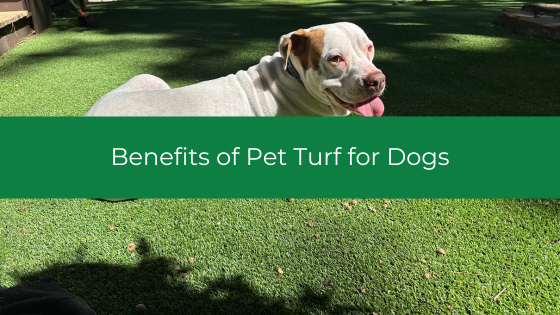
Dog owners rarely ask whether artificial grass looks good. They ask what happens to the urine, whether the yard still turns to mud by the back door, and whether the dog will dig straight through it. Those are the right questions, and they have specific answers.
A pet turf installation is not simply a different surface. It is a drainage system with grass on top, and almost everything a dog does to a lawn is a drainage problem underneath. Here is how artificial grass handles the four things that wreck a natural yard in The Woodlands: urine and odor, mud, worn bare lanes, and digging.
Dog Urine, Odor and Why Artificial Grass Does Not Yellow
Urine kills natural grass because it sits in the soil. The nitrogen burns the blades and leaves the yellow ring every dog owner recognizes, and the smell lingers because there is nowhere for it to go.
Artificial grass has no living blades to burn, so those yellow patches never form. Liquid passes straight through the permeable backing into the compacted base below, the same way rainwater does. That is why the base matters more than the turf on top of it. A properly graded and compacted base moves urine down and away from the surface. A poor one holds it, and held liquid is where almost every odor complaint actually starts.
Infill is the other half of the answer. Silica sand is the standard ballast that keeps the fibers upright. Zeolite is the one dog owners tend to ask about, because it captures ammonia as urine passes through and releases it when the surface is rinsed. Either way the upkeep is simple: rinse the areas your dog favors, and brush the fibers back up afterward. If a yard has had dogs on it for years and the smell has had time to build in, our artificial turf cleaning service handles the deep clean a garden hose cannot.
Mud, Worn Lanes and Dead Patches
Every dog has a route. The lap around the fence line, the track from the back door to the gate, the shaded spot under the tree. On a natural lawn those routes go bare within a season, and bare soil in a Gulf Coast rain means mud, and mud means paw prints through the house.
Artificial grass has no route to wear out. There is no exposed soil for a dog to turn over, so the lane your dog runs stays the same color as the rest of the yard. After a heavy storm the surface drains instead of puddling, which is the difference between letting the dog out that afternoon and waiting two days for the yard to dry.
It is the same reason the surface holds up on residential lawns, in apartment complexes and condos where shared pet areas take constant traffic, and at dog parks that would otherwise be dirt by midsummer.
Digging, Paw Safety and Cleanup
Dogs dig at soil. Artificial grass laid over a compacted aggregate base does not give them soil to dig at, and the perimeter is secured during installation so there is no loose lip to start on. A dog that digs out of boredom will still try. What changes is that there is nothing to show for it afterward.
The surface itself is non-toxic and safe for dogs to lie on, and the shorter pile heights used in pet areas drain faster and are easier to clear. Solids get picked up the same way they do on natural grass, and the spot gets rinsed. Nothing about owning a dog becomes harder. The yard simply stops keeping score.
If you are weighing this up for a particular yard, the dog run and pet turf installation page covers how we build it, and every quote is complimentary.
Dog Owner Questions About Artificial Grass
Does artificial grass smell when dogs use it?
Not when it is installed and maintained properly. Odor comes from liquid that has nowhere to drain, so the compacted base under the turf does most of the work. A permeable backing over a well graded base lets urine pass through instead of sitting in the surface.
How do you get dog urine smell out of artificial grass?
Rinse the areas your dog uses most, then brush the fibers back upright. For a yard where odor has built up over years, a deep clean reaches the infill and the base rather than just the surface, which is what our artificial turf cleaning service is for.
Does dog urine damage artificial grass?
No. There are no living blades to burn, so urine does not leave the yellow rings and dead patches it leaves on a natural lawn. The fibers and backing are not affected by it.
Can dogs dig through artificial grass?
It is very difficult. The turf sits over a compacted aggregate base with no loose soil underneath, and the edges are secured during installation, so there is no lip for a dog to work at. A determined digger may still try, but there is nothing to dig into.
Is artificial grass safe for dogs in Texas heat?
Yes, and shade and infill both make a difference to how the surface feels on a hot afternoon. Rinsing the area cools it quickly, and pet areas are usually built with a shorter pile that drains and sheds heat faster than a long landscape pile.
- 5 Questions to Ask Before Hiring an Artificial Turf Contractor - October 2, 2026
- Nutsedge Growing Through Artificial Turf? Why It Happens and What We Did - September 4, 2026
- Can Artificial Turf Help with Allergies? - July 15, 2026